

 The Japanese Art Society of America (JASA) promotes the study and appreciation of Japanese art. Founded in 1973 as the Ukiyo-e Society of America by collectors of Japanese prints, JASA’s mission has expanded to include related fields of Japanese art. Through its annual lectures, seminars and other events, the Society provides a dynamic forum in which members can exchange ideas and experiences with experts about traditional and contemporary arts of Japan.
Celebrating 50 Years of JASA—and Building Our Exciting Future!
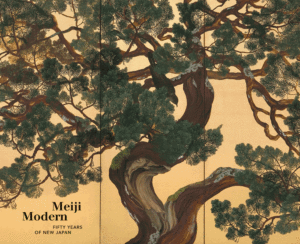
JASA’s groundbreaking 50th anniversary exhibition, Meiji Modern: Fifty Years of New Japan, took place from October 2023 to September 2024 to great acclaim, attracting thousands of visitors at venues in New York, Chicago and Houston. JASA’s beautiful 272-page full-color catalog for the exhibition (cover at left) takes a fresh look at the art of the Meiji period (1868-1912) through approximately 200 objects drawn from public and private collections across the United States, including newly discovered prints, photographs, textiles, paintings and craft objects. Copies of the catalog can be ordered through the JASA Store or our mail-in Publications Order Form.
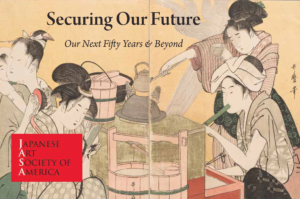 JASA has embarked on a major capital campaign. Our goal is to raise a total of $2.5 million to help secure our future as the premier membership organization in North America dedicated to the arts and culture of Japan. We have already raised a substantial portion to cover the costs of the Meiji Modern exhibition. However, we also need your help to secure additional funds to support Impressions, JASA programming and scholarship in Japanese art history Download our Securing Our Future brochure here and watch the video here to learn more about this important initiative and how you can be part of building JASA’s exciting future!
Meet JASA’s New President: Victoria Melendez
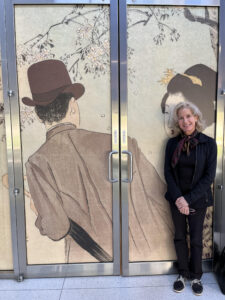
Impressions recently met with Victoria Melendez, elected the society’s president in 2024, in the galleries of the Department of Arms and Armor at the Metropolitan Museum of Art, where we had just viewed an onsite presentation of Japanese swordsmanship. While she is well-known to many JASA members and fellow collectors, we invited Victoria to share some of her background and views on collecting Japanese art.
We are delighted to speak with you about your new leadership role with JASA. Members look forward to getting to know you better and to working with you. To begin our short conversation, please tell us about your early years. Where were you born? Where did you grow up, go to school?
I was born and raised in New York City. I attended the Fiorello H. LaGuardia High School of Music & Art and Performing Arts, where I focused on painting and drawing.
Were your parents both interested Japan, or in art? What interested you as a child?
My parents were both interested in art, such as painting and ancient art, and when I was a child often took me to museums, such as the Metropolitan Museum of Art. Rather than Japan, they were more interested in Spain and Latin America, probably because my father was from Colombia and my mother was a Spanish teacher.
Read our complete conversation with Victoria Melendez here.
JASA October Events
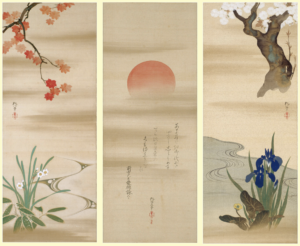 Our JASA trip to New Orleans October 2 to 4, organized by the New Orleans Museum of Art for the exhibition Second Nature: Japanese Rinpa Paintings from the Gitter-Yelen Collection, featured a selection of 60 works by artists of the Rinpa tradition in the collection. The trip included the VIP opening; a special private tour of the exhibition; a half-day symposium on Rinpa; and a visit to the Gitter home and collection hosted by Alice Yelen-Gitter.
Our Zoom webinar Unlocking the History of Meibutsu was streamed live Tuesday, October 6, 5 p.m. EDT. In this talk, Christine Guth, art historian and scholar, unlocked the long and multifaceted history of meibutsu and its role in laying the foundations for the identification, classification and preservation of Japanese cultural heritage. If you missed this October 6 Zoom webinar, the video is posted below.
For details of these upcoming events, see our JASA-Sponsored Events page.
You can also find links and details for all recorded JASA events on our Lecture Videos page.
- Lecture: Unlocking the History of Meibutsu (Dr. Christine Guth) October 8, 2026Unlocking the History of Meibutsu (Lecture by Dr. Christine Guth)

Our October 6, 2026, lecture focuses on the topic of meibutsu with Christine Guth, art historian and scholar, drawing on her recent book Exemplary Things: Meibutsu in Premodern Japan. In this talk, Dr. Guth unlocks the long and multifaceted history of meibutsu and its role in laying the foundations for the identification, classification and preservation of Japanese cultural heritage.
Meibutsu is a Japanese cultural keyword—with no exact anglophone equivalent—that has had a pervasive and enduring influence in Japan. Literally meaning “famous thing” or “thing with a personal name,” it has served to designate articles of the highest quality, from utensils used in the tea ceremony, swords and incense, to regional crafts and foodstuffs. Initially, this honorific was applied to luxury goods imported from China collected by the elite but over time it became a branding device for domestic products, especially those available along the heavily traveled Tokaido Road linking Kyoto and Edo.
- JASA Conference Travel Support Awards October 8, 2026The Japanese Art Society of America (JASA) invites applications from PhD candidates and faculty members who have had a paper on the subject of Japanese art accepted at an academic conference, for an award to support the costs of conference presentations. Expenses eligible for reimbursement include travel, accommodation, and conference fees up to the amount of $2,500. Upon completion, recipients will be asked to make a 10-minute Zoom presentation on their conference paper during a JASA program. Two awards will be given annually. Applications are due December 11, 2026. Successful applicants will be notified in January 2027.To apply, please submit paper title and abstract together with confirmation of acceptance to the academic conference, budget, details of any other sources of funding to which the applicant has applied, and CV to JASATravelGrant@gmail.com.
- Impressions 47 (2026) September 8, 2026
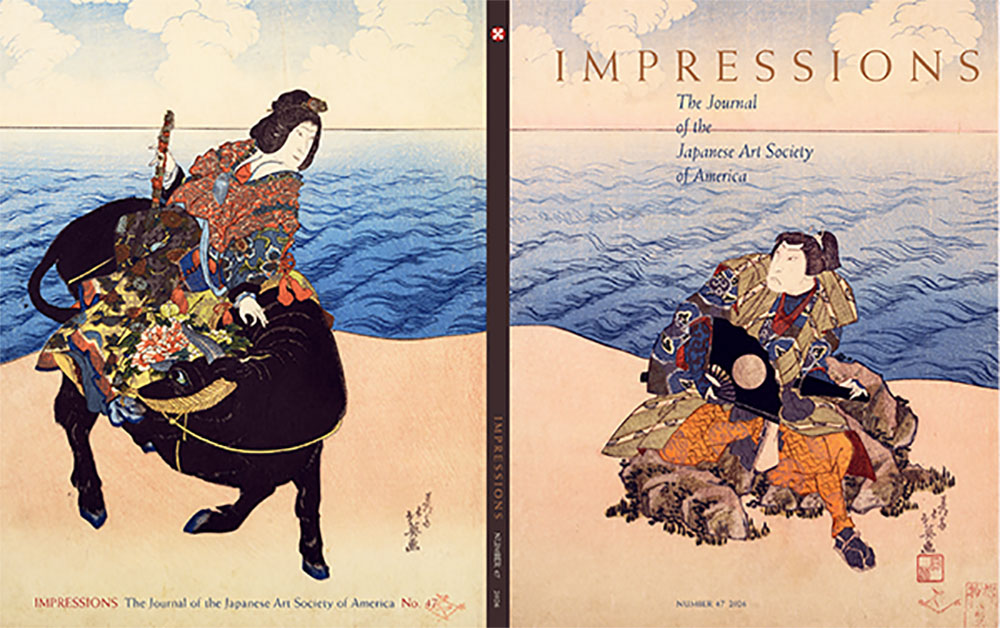 Impressions 47 (2026) has arrived! Essays discuss Takashi Murakami and his experimentation with ukiyo-e subjects. We introduce the dealer Hasebe Jun’ichi, feature reviews of John Fiorillo’s book on Hokuei and an exhibition of Hokusai in Rome, and we include a photomontage of Harry Packard’s Japanese pots at the Met. Tributes are given to Suzanne Valenstein and Peter Dailey. (View the Table of Contents here.) Additional copies can be ordered for $25 (plus shipping) through the JASA Store or our online Publications Order Form.
 - Lecture: In the Flesh: The Nude in Modern Japan (Dr. Rhiannon Paget) July 2, 2026In the Flesh: The Nude in Modern Japan (Lecture by Dr. Rhiannon Paget)

In this July 1, 2026, lecture, Dr. Rhiannon Paget, Curator of Asian Art at The John and Mable Ringling Museum of Art, Florida State University, introduces her current exhibition, In the Flesh: The Nude in Modern Japanese Art, featuring prints and one painting from the 1910s to 1970s. Dr. Paget discusses how the nude entered Japanese art at the end of the 19th century, the debates it sparked, the ways artists responded to evolving expectations in the early modern period, and how the genre developed across the 20th century.
On view February 21 to August 23, 2026, the exhibition explores the emergence of the nude as a provocative and transformative subject in Japanese art from the late 19th century through the postwar period. Long associated in Japan with erotic imagery rather than fine art, the unclothed body became a focal point for debates about morality, modernity and artistic freedom as artists engaged with Western academic traditions.
As Japanese artists encountered new ideas about anatomy, realism and the expressive potential of the human form, the nude gradually entered the repertoire of modern painting, printmaking and other media. Bathing, grooming, and moments of private introspection offered socially acceptable frameworks for depicting the unclothed figure, while later modernist artists pushed beyond idealized forms toward bold color, abstraction and psychological intensity.
Featuring works on paper and an arresting oil painting by Ishikawa Toraji, In the Flesh traces how artists reimagined the body in response to changing social norms and artistic priorities. Predominantly images of women, these works reflect both the conventions of the genre and the perspectives of the artists and audiences who shaped it. Together, they reveal how the nude became a site for negotiating gender, desire and artistic identity in modern Japan.
- Lecture: Bunmei Kaika: Political Landscape in Early Modern and Modern Japan (Monique D’Almeida) June 6, 2026Bunmei Kaika: Political Landscape in Early Modern and Modern Japan (Dr. Monique D’Almeida)

On view through June 7, 2026, at the Frances Lehman Loeb Art Center, Vassar College, Poughkeepsie, the exhibition Bunmei Kaika explored the impact of the late Edo- and Meiji-period political climate on culture, thought, and the dissemination of prints in Japan. In this live webinar on June 2, Chelsea Foxwell, Professor of Art History, University of Chicago, in conversation with the exhibition’s curator, Monique D’Almeida, Deknatel Curatorial Fellow in Japanese Works on Paper, examines how the drastic shift in Japan’s national identity during the 19th and early 20th centuries was reflected and disseminated in prints during this time of expansion and modernization.